Muybridge, Sallie Gardner, and the Making of Motion Legible
A cabinet card and a newspaper account from 1878 show how automated capture first made motion analyzable.
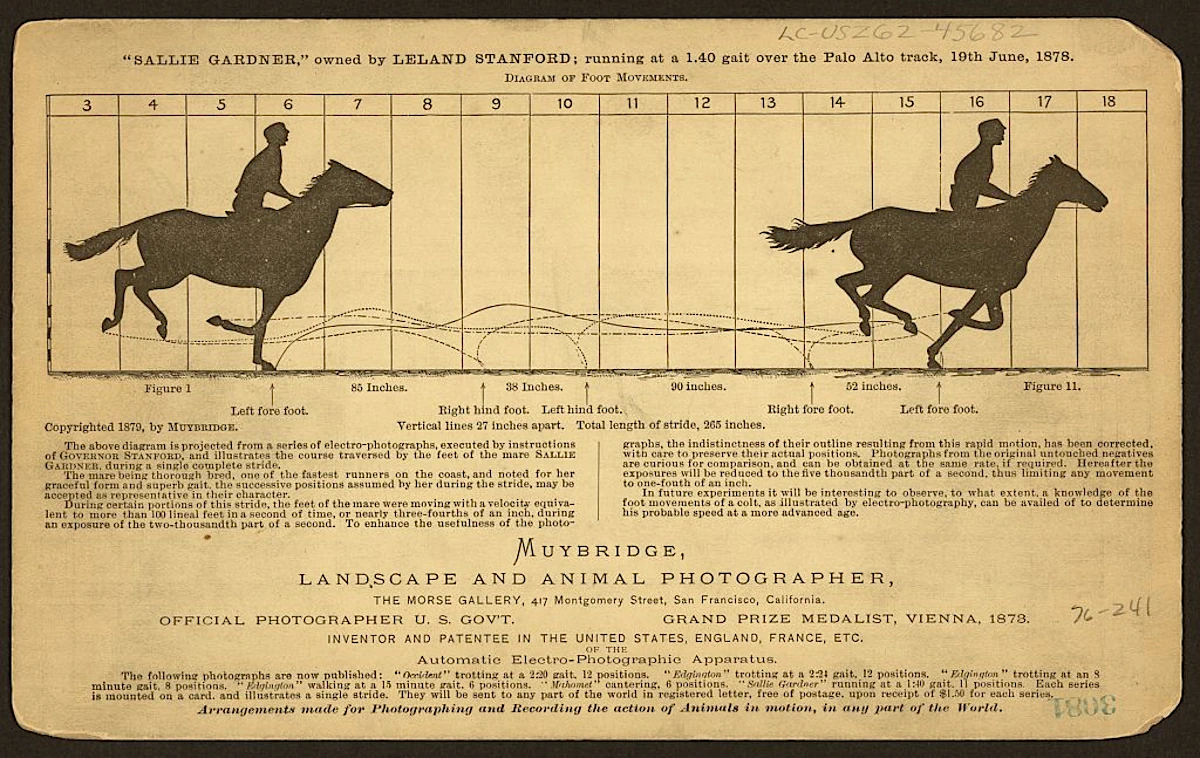
On a Saturday in June 1878, at Leland Stanford's stock farm near Menlo Park — on land that would become part of the Stanford University campus — Eadweard Muybridge set twelve cameras along a track and photographed the racing mare Sallie Gardner at a full gallop. The images made rapid motion legible. What the naked eye could not parse — the exact positions of a horse's legs at forty feet per second — the camera rendered available for examination.
This exhibit presents two primary sources from the event. The cabinet card above, produced by Muybridge for sale at Morse's Gallery in San Francisco, compresses the experiment into a single object: sequential photographs, a diagram of foot movements, and a price list. The second source, reproduced below, is a detailed account published six days later in the Pacific Rural Press, describing the apparatus — cameras, wires, electrical triggers — with the specificity of an engineering report. Together, the card and the article reconstruct the event from opposite directions: one visual and commercial, the other verbal and technical.
Reading the Card
The card identifies Muybridge as “Landscape and Animal Photographer” — a job title that would have been legible in 1878 but conceals how novel the work actually was. Landscape photography was already established; systematic sequential motion photography was still an emerging experiment. The card’s understated self-description is a small masterpiece of commercial positioning: it anchors an entirely new technology in a familiar professional category.
The credential line reads: “Official Photographer U.S. Gov’t. Grand Prize Medalist, Vienna, 1878.” Here Muybridge leverages institutional authority to validate work that had, as the newspaper account makes clear, “excited more ridicule than praise” when first attempted the previous year with the horse Occident.
The header identifies the mare as “running at a 1.40 gait” — a mile in 1 minute 40 seconds, or roughly 36 miles per hour — and the text below describes the images as “projected from a series of electro-photographs,” Muybridge’s term for pictures made with his electrically triggered “Automatic Electro-Photographic Apparatus.” At the bottom, the card lists all available series — Occident trotting, Edgington trotting, Edgington walking, Mahomet cantering, and Sallie Gardner running — along with exposure counts and gaits. Available by mail from Morse’s Gallery at 417 Montgomery Street for $1.50 each, the card presents a new visual technology in the familiar form of animal studies and gait records. The card is copyrighted 1879, though the photographs were taken in June 1878.
“Like a Whirlwind”
Six days after the Palo Alto experiments, the Pacific Rural Press published the following account — perhaps the most detailed contemporary description of Muybridge's apparatus and method. It is reproduced here in full. The article moves from the camera-and-wire triggering system, to the trotter Abe Edgington, to the galloping Sallie Gardner, and finally to the social world of Governor Stanford's ranch. Where the card above compresses the experiment into a single visual object, the newspaper expands it into narrative.
The Stride of a Trotting Horse.
Photographing a Horse while Traveling Forty Feet a Second.
We had the pleasure of witnessing on Saturday last the successful accomplishment of a feat in photography which has never been excelled, and which marks an era in the art, viz., taking a series of photographs of a trotting horse while at full speed, so as to illustrate the stride. A series of experiments with this end in view have been made by Muybridge, the photographer, at the instance of Gov. Leland Stanford, and the trial on Saturday showed how perfectly the work could be done. The experiments have been conducted at El Palo Alto farm, Menlo Park, where Gov. Stanford has established a stock farm for breeding thoroughbred horses, and where there is a fine track over which the horses could be sped.
Some five years ago Gov. Stanford asked Muybridge if it were possible to take a photograph of a trotting horse at full speed, but at that time it was considered impossible. About a year since, however, the experiment was tried and a photograph of “Occident” was taken while the horse was traveling 36 feet per second. It was a single picture, however, and excited more ridicule than praise, as most people thought the whole thing a humbug, not believing it possible for the picture to be taken, and not believing the position of the horse to be natural.
This initiatory attempt has been followed up, however, until on Saturday last a series of 12 pictures were taken in less than half a second, while the horse was traveling 40 feet per second. These pictures illustrate the stride of the trotter precisely, and although they upset many preconceived theories and opinions, may be regarded as decisive.
The method of taking the pictures is by no means complicated, and when once understood will be seen to be perfect, but several different ways were tried before a successful one was found.
On one side of the track a large screen is placed, and set at an angle of about 20 degrees from the perpendicular, the screen being covered with white cloth and having vertical lines formed across it 21 inches apart, which show black against the white cloth. The spaces between these lines are numbered from one to twenty in conspicuous black figures at the top. At the bottom is another low white screen with horizontal lines four inches apart, to show the hight of the horses feet above the ground. Powdered lime was sifted over the track in front of the screen so as to make a perfectly smooth white surface, over which the horse was driven.
On the opposite side of the track from the screen a low shed was erected, open in front, and on a bench or table were placed 12 cameras, numbered in order, so as to take 12 views 21 inches apart. These cameras were of English manufacture and constructed with an improved double slide, so that the exposure could be cut off instantly, one slide moving each way across the lens. The slides were held open by a catch connected with an armature in the side of the camera. A battery of eight jars was placed in the shed and each camera had an independent set of wires. These wires were led across the track under the ground until within two feet of the background or screen, where they were raised so that one of the sulky wheels would pass over and strike them.
The wires corresponded with the vertical lines on the background, and as the sulky wheel passed over the wires the armature holding the catch of each separate instrument released the catch and the slides cut off the exposure of the camera at the instant, so that the photograph was taken without any blur. As the wheel passed over the different wires the different pictures were taken, each 21 inches apart, illustrating perfectly the stride of the horse.
The trotter “Abe Edgington” was brought out on Saturday, and after being warmed up a little over the track, after the apparatus was all ready, he was put to a 2:20 speed past the screen. He came down the track in splendid style, with a good, square motion and firm trot. As soon as the wheel struck wire No. 1, camera No. 1 was closed by the means described, and the first picture taken; when it struck No. 2 the second camera had the second picture, and so on until 12 pictures were taken 21 inches apart.
The arrangement insured accuracy which was unquestioned. The horse was traveling about 40 feet per second and there were 12 distinct and separate pictures taken in a space of 21 feet, each in an inappreciable part of a second. The sound of the slides closing was like a continuous roll, so quickly was the feat accomplished. The negatives were perfect, without any signs of blur or indistinctness.
It would be impossible to describe the various positions of the horse's feet at different points of the stride, but there are positions which one would scarcely imagine, but which could not be questioned by those who witnessed the operation. At one point all four feet are off the ground, the two nearest being eight inches above it. Some of the positions are very curious, indeed, but one needs to see the photographs to appreciate them. Muybridge intends to mount the whole 12 on one card on a small scale, so that any one can procure them at Morse's gallery.
In photographing a running horse the wires could not be used in the same way for manifest reasons. Fine black threads were placed across the track, 21 inches apart, and connected so that the armatures would release the slides as before. The racing mare “Sallie Gardner,” a handsome animal, was brought out and the threads placed so as to strike her breast as she went by. The instruments were made ready, the signal given, and she came rushing down the track like a whirlwind.
As the threads successively, by the means described, released the catches and closed the slides, the 12 pictures of the running horse were taken. When the mare broke the eighth or ninth thread she became aware of something across her breast, and gave a wild bound in the air, breaking the saddle girth as she left the ground. This gave a curious picture of the mare with her legs wildly spread and the broken girth swinging in the air just as it is separating. This series of pictures are also very interesting but difficult of description. They show, however, the gait of the running horse exactly, and in a manner before impossible.
A long description even would be unintelligible, while the photographs show the whole stride at a glance. With the trotting horse the motion of each foot can be followed throughout the stride, and accurate measurements taken by the aid of the vertical and horizontal lines. It is curious to notice that the propelling power of the horse seems all in the hind legs, while the front ones seem only used to support the body.
Another curious feature noticed was that the sulky was only on the ground about half the time. The ground was perfectly smooth and even, having been carefully rolled, and the powdered lime sifted on gave an excellent surface for observation. The track made by the wheels show they were moving in short bounds, as if the spring of the felloe between the spokes threw the wheel off the ground at the spokes. The wheel would make a mark for about six inches, and then none for about four inches, and so on with considerable regularity.
Gov. Stanford has gone to considerable trouble and expense in having these experiments conducted so thoroughly, and Mr. Muybridge, who is an enthusiast in his art, has carried them out skillfully. The electrical portion of the appliances were made in this city by the San Francisco Telegraph Supply Co. The results are highly satisfactory, and cannot be caviled at.
Quite a number of gentlemen witnessed the experiments, among them representatives of the principal daily and weekly papers, and quite a number who make turf matters a specialty. The application of electricity as an adjunct to the camera was perfectly satisfactory in every respect, and the pictures were as accurate as possible. The series of photographs will be of great interest to all having any interest in horses, as they show conclusively how the stride is accomplished at high speed, a subject on which there has been a wide difference of opinion. These pictures, however, settle the matter conclusively, and many will have to give up their ancient prejudices.
The Seeing Machine
What the reporter grasped most clearly was that the novelty lay not in the images alone, but in the system that produced them.
What is striking about the apparatus at Palo Alto is who — or what — operated it. The camera’s shutter was triggered not by a human hand but by the subject itself, the horse’s body completing an electrical circuit as it moved through space. The photographer designed the system; the animal activated it.
This displacement of the human operator — from direct agent to designer of conditions — marks an important early moment in the history of automated image-making. Muybridge did not invent machine vision, but the Palo Alto track demonstrates an early and vivid instance of its logic: set the parameters, then let the apparatus capture what the eye cannot. That the results were immediately offered for sale, mounted on cards at a dollar and a half each, shows how quickly this new visual system entered commercial circulation.
The reporter dwelt not on the images themselves (“a long description even would be unintelligible”) but on the apparatus that produced them. The story of Sallie Gardner is not only the story of a horse. It is the story of a system — camera, wire, battery, shutter, screen, powdered lime — built to make motion legible. The images were evidence. The machine was the argument.
One passage on the card points beyond the experiment itself. In the text beneath the images, Muybridge writes: “In future experiments it will be interesting to observe, to what extent, a knowledge of the foot movements of a colt, as illustrated by electro-photography, can be availed of to determine his probable speed at a more advanced age.” This is not merely a record of what was done; it is a proposal for what might be done next — the idea that recorded gait could be used predictively. Later researchers did pursue that possibility, and movement analysis now plays a role in evaluating young horses. In that sense, Muybridge’s card does more than document a breakthrough in recording motion. It also sketches an early predictive use for it.
Scroll back to the card: eleven frames, a diagram of feet, a price, and an address on Montgomery Street — a modest object, and an early record of how a machine could be arranged to make motion visible.