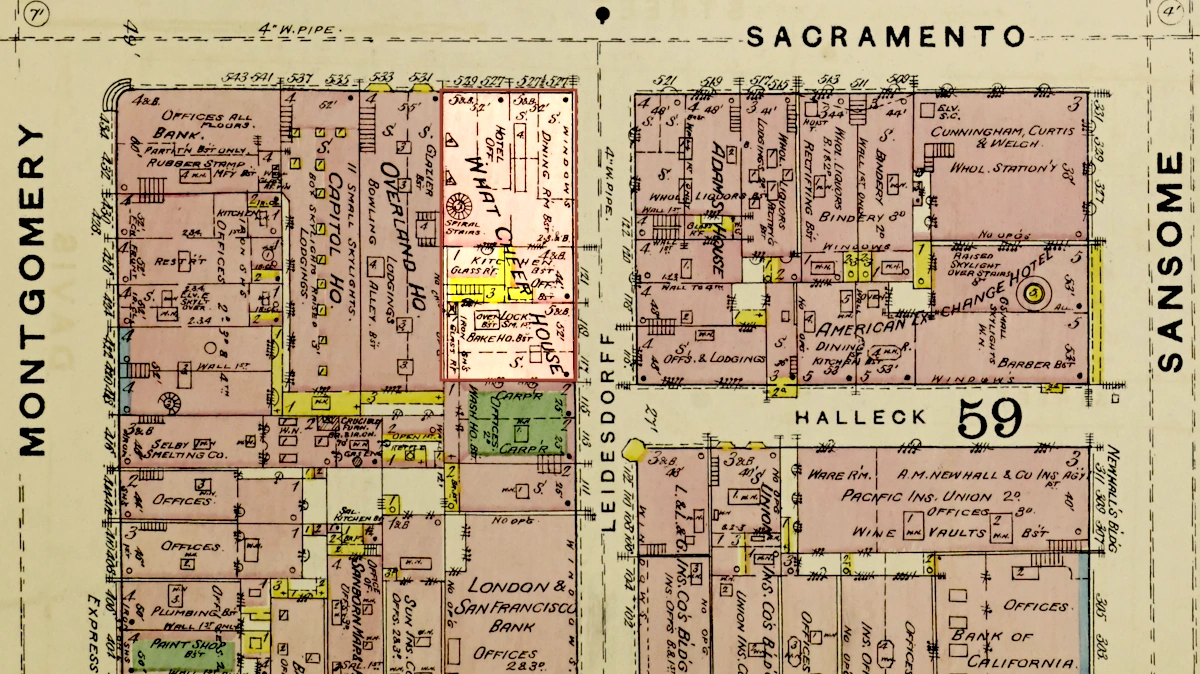
About What Cheer House
What Cheer House creates research-grounded cultural exhibits for the web — combining archives, storytelling, and art, designed to feel at home in museums, schools, libraries, and galleries.
Based in San Francisco, What Cheer House begins with historical materials: ledgers, maps, newspapers, murals, photographs, catalogs, datasets, and overlooked collections. These sources become the foundation for exhibits, essays, visual works, and interactive experiences.
At its core, What Cheer House is a studio for archive-driven public imagination. Through careful research, strong visual design, and contemporary digital form, it brings underused cultural materials into public view.
Historical Context
The original What Cheer House stood at the corner of Sacramento and Leidesdorff streets in San Francisco’s early commercial district. Completed in 1852 by entrepreneur R. B. Woodward, it became one of the best-known establishments of Gold Rush–era San Francisco. Designed to serve laborers, sailors, immigrants, and others passing through the city, the house offered clean lodging and substantial meals at modest prices.
Beyond lodging and dining, the What Cheer House developed an unusual cultural dimension. The building's reading room, stocked with several thousand volumes and newspapers from around the world, is recognized as San Francisco's first free library. In 1860, Woodward expanded the enterprise further, opening what is considered the city's first museum — a collection of natural history specimens, minerals, and curiosities gathered from across the Pacific.
Throughout the nineteenth century, the What Cheer House functioned as a crossroads of early San Francisco society. Merchants, immigrants, travelers, writers, and fortune seekers passed through its public rooms. Though the original building no longer stands, its combination of hospitality, curiosity, education, and public culture remains a powerful model.
What We Do
What Cheer House turns archival and cultural materials into public-facing exhibits, essays, visual works, and interactive experiences. A project may begin with a nineteenth-century museum ledger, a historic mural, a local newspaper archive, a neglected catalog, a map, a collection of photographs, or a dataset that needs interpretation. Work begins with these primary sources and, where useful, computational tools—data analysis, mapping, and visualization—to reveal patterns and relationships that might otherwise remain difficult to see. Technology serves as an instrument of interpretation, not a substitute for judgment; historical context, visual craft, and editorial care guide the work throughout.
In this role, What Cheer House can serve as a creative partner for museums, schools, libraries, archives, historical societies, and cultural organizations that want to bring collections to life but may not have the internal capacity to develop experimental public-facing digital exhibits.
Program Areas
Work at What Cheer House is organized across three public programs:
- Archive—curated historical materials, contextual essays, primary documents, and collection-based projects drawn from cultural and institutional sources.
- Research—investigations that combine archival evidence, historical interpretation, and computational methods to explore cultural questions.
- Art—visual, generative, and studio works developed through research-driven artistic practice.
Together, these programs create a public framework for archive-driven storytelling, cultural research, and artistic interpretation.
Two Layers, One Practice
What Cheer House operates across two connected layers. The website is the public-facing research, storytelling, and prototype layer — where archival materials are first interpreted, tested, and presented. Physical installations extend that work into museums, schools, libraries, and galleries, forming an exportable, institution-ready layer built on what the web work has already proven.
Every major exhibit is designed to succeed in both: beautiful online, credible as scholarship and storytelling, and imaginable as a physical installation from the start.
Principles
- Research Integrity—Sources are cited, historical context is preserved, and interpretation remains transparent.
- Public Imagination—Archives are presented as living cultural materials, capable of inspiring curiosity, learning, and new forms of engagement.
- Computational Responsibility—Machine intelligence and computational methods are used deliberately, with human judgment, documented process, and clear interpretive purpose.
- Exhibition Clarity—Complex systems are presented with restraint, legibility, and accessibility for public audiences.
- Enduring Craft—Works are designed to remain meaningful beyond short technological cycles.
Who We Are
What Cheer House was founded and developed by Matt Savage, a software developer, cultural technologist, and archival researcher based in San Francisco.
Matt’s work spans archival research, data systems, computational interpretation, and public-facing digital exhibits. His archival practice includes substantial work correcting historical newspaper text in the California Digital Newspaper Collection, where he is listed among its “Text Correctors Hall of Fame” contributors.
At What Cheer House, he develops the research systems, editorial methods, and technical forms through which archival materials can be examined, interpreted, and presented for public audiences.
What Cheer House collaborates with artists, researchers, educators, technologists, and cultural organizations as projects develop. Artistic partnerships, contributor credits, and project roles are shaped around the specific needs, permissions, and responsibilities of each work.